
kmeans clustering
v1.0.2Do a kmeans clustering with sklearn
kmeans clustering
Do a kmeans clustering with sklearn
What it does
Groups the rows of a table into K clusters with scikit-learn’s
KMeans,
then adds a column holding each row’s cluster label (0 … K-1). Reach for it to segment
records by similarity — customers by behaviour, observations by shape — when you have a few
numeric columns and want an unsupervised grouping rather than a rule you write by hand.
The node runs in the kernel environment (it needs scikit-learn). Clustering is
deterministic: n_init=10 and a fixed random_state=42, so the same input and settings
always produce the same labels.
Inputs
A single table. It must contain the numeric columns you select as features; other columns are passed through unchanged.
Settings
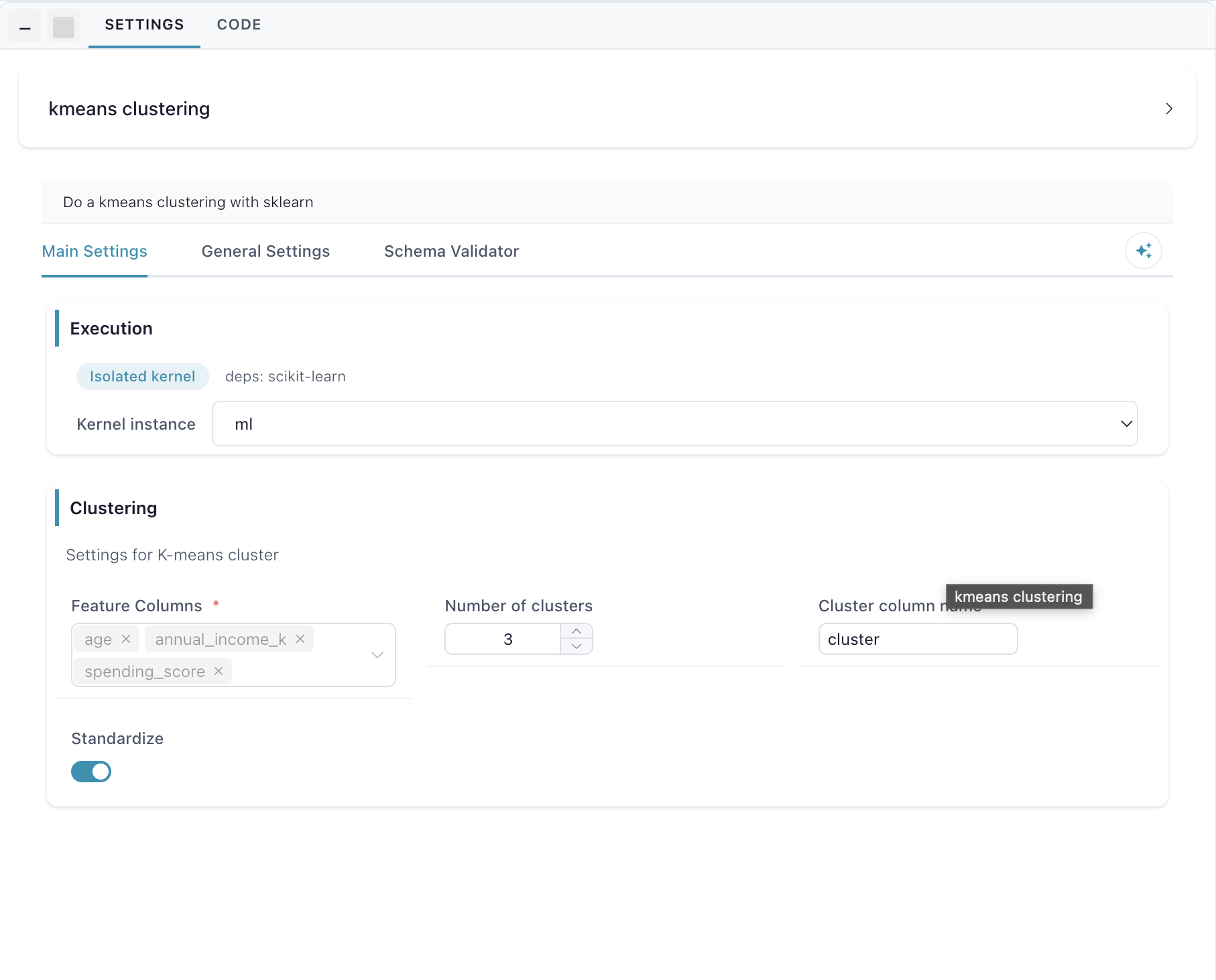
- Feature Columns (required) — one or more numeric columns to cluster on. Only these columns feed the model.
- Number of clusters — K, the number of clusters to fit (2–20, default 3).
- Cluster column name — name of the label column added to the output (default
cluster). - Standardize (default on) — z-score the features with
StandardScalerbefore fitting, so columns on different scales (e.g. age vs. income) contribute evenly. Turn off to cluster on the raw values.
Output
The input table with one extra integer column (named by Cluster column name) giving the cluster each row was assigned to.